

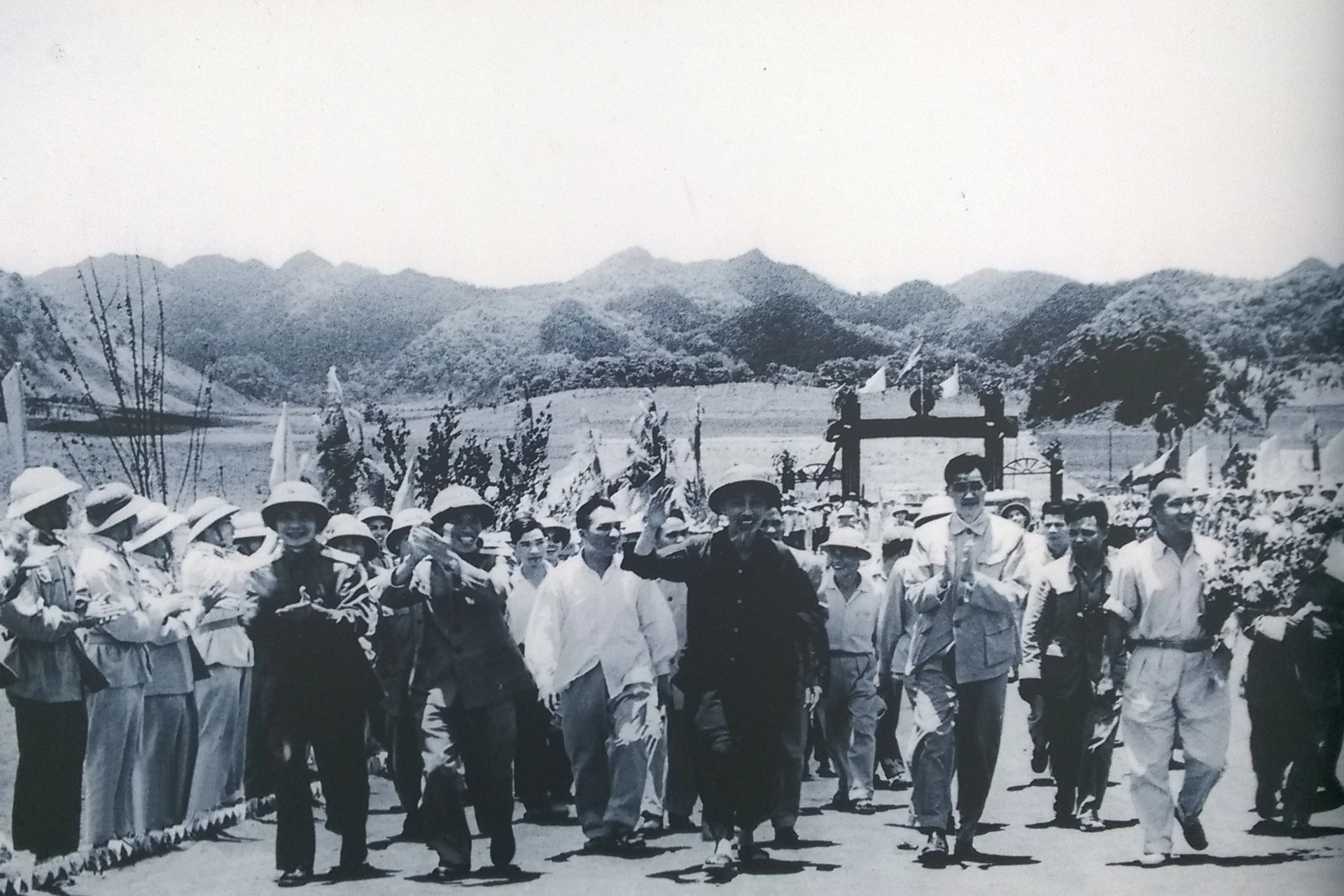
Uncle Ho visits Moc Chau Farm on May 8, 1959
Moc Chau – a land blessed by nature with a temperate climate, fertile soil, and poetic landscapes – is not only famous as an attractive tourist destination but also a land deeply marked by the nation’s history. From the feudal era to the colonial period, this place was once a strategic area, witnessing many battles to defend the homeland’s borders.
Through historical periods, with the resilient will and self-reliant spirit of the people of all ethnic groups, Moc Chau has gradually risen to become a dynamic development center for economy, culture, and society in the Northwest region. Today, the announcement of the establishment of Moc Chau Town along with the title of National Tourist Area is proof of the increasingly affirmed position of this land, opening a new chapter for a brilliant future amid the plateau.
1. Historical imprints from the Lê dynasty – the origin of the name “Moc Chau”
From the late 14th century, Moc Chau residents migrated to areas such as Phieng Luong, Chieng Di, Cho Long, and Na Bo, forming the first villages in the Muong Sang area. By the reign of Lê Thánh Tông (1434), the court officially recognized the territory of Muong Sang and renamed this land Moc Chau, belonging to Gia Hung Prefecture, Thanh Hoa region.
At that time, Moc Chau was a crucial frontier region of the Lê dynasty court. According to the Đại Việt sử ký toàn thư (Complete Annals of Đại Việt), from the 14th to 15th centuries, this land was associated with many historical figures such as Xa Kha Tham, Xa Loc, Xa Ban, and Xa Diem – local leaders loyal to the court, who contributed to protecting the borders, quelling rebellions, and safeguarding the land to the West of the homeland. Their descendants continued to assume the role of phụ đạo (local administrators) of Moc Chau through many dynasties, strengthening security in the Northwest region.
2. Imprints of the French colonial period – Moc Chau in the French exploitation vision
During the French colonial period, Moc Chau was assessed by surveyors as the plateau with the foremost agricultural potential in Indochina. Resident Superior Sevenier once described Moc Chau as “a lush green plateau, with a temperate climate, fertile soil – a place where large-scale diversified agriculture could be developed.”
After completing Route 41 and the Moc Chau – Sam Neua road, the French set the goal of turning this place into a strategic trading hub on the Hanoi – Hoa Binh – Lai Chau – Sam Neua route. On February 24, 1936, the Governor-General of Indochina and the Resident Superior of Tonkin personally attended the inauguration ceremony of this important road – evidence of Moc Chau’s significance in the transportation network of the Northwest region.
Even in 1937, the colonial administration proposed a plan to resettle 10,000 people from the Northern Delta to Moc Chau for land reclamation and agricultural development. However, due to the outbreak of World War II, this plan was interrupted and never carried out.
3. Moc Chau during the resistance war – A solid revolutionary base area
During the resistance war against the French (1946-1952), Moc Ha (now Van Ho District) became an important base area of the Son La Provincial Party Committee, where the headquarters and strategic rear were located. With its position as the gateway to the Northwest and Upper Laos, Moc Chau was not only a foothold for the resistance forces but also the starting point of many major campaigns on both the Vietnamese and Lao battlefields.
After the Dien Bien Phu victory in 1954, the people of all ethnic groups in Moc Chau set out to restore the economy, develop culture, stabilize their lives, and gradually build socialism. Despite facing many difficulties, the people here remained resilient in production and combat, actively contributing to both the North and the South.
4. The period of renewal and development – Prosperity amid the green steppe
On November 15, 1968, Moc Chau Farm Town was established, marking a new step in the agricultural and economic development of the highland region. In early 1974, with the help of Cuba, the Moc Chau Dairy Farm was born – a symbol of international friendship and the foundation for the famous Moc Chau milk brand later on.
Through the periods of war and renewal, Moc Chau has always maintained a pioneering role in the socio-economic development of the mountainous region, especially in agriculture, tourism, and processing industry. The people of Moc Chau uphold the tradition of diligence and solidarity, vigorously promoting economic restructuring toward industrialization and modernization, constantly improving both material and spiritual life.
5. A new turning point – From National Tourist Area to Moc Chau Town
Thanks to the concerted efforts of the government and the people, on April 22, 2024, the Ministry of Culture, Sports and Tourism issued Decision No. 1077/QĐ-BVHTTDL, recognizing Moc Chau as a National Tourist Area – marking a major step forward in the journey to affirm the tourism brand of this highland land.
Subsequently, according to Resolution No. 1280/NQ-UBTVQH15 dated November 14, 2024, Moc Chau District was officially upgraded to a town. On January 18, 2025, the ceremony announcing the establishment of Moc Chau Town was solemnly held – an event opening a new development phase, aiming to build a dynamic, modern urban area that harmoniously combines traditional cultural identity with sustainable development.

Vice Chairwoman of the National Assembly Nguyen Thi Thanh presents the Resolution on the establishment of Moc Chau Town